Resetting your air conditioning is a valid option under the appropriate circumstances, particularly when a power or control malfunction has occurred. Still, I always remind customers that you should not use it as the first or only option whenever an issue arises.
From my experience, many people have to reset their air conditioners due to minor maintenance issues.
With the system straining, it might malfunction or stop responding, leaving homeowners trying to figure out how to reset an air conditioner rather than solving the problem.
As an air conditioning technician in Perth, it is not uncommon for people to ask how to reset an air conditioner if a system unexpectedly stops functioning.
Ultimately, I advise that while knowing how to reset an air conditioner is useful, the best results come from prevention.
Routine air conditioner servicing, proper installation, and proper maintenance reduce the likelihood of resetting the system and help ensure that air conditioners operate reliably.
Signs Your Air Conditioner Needs a Reset
It happens that some air conditioning systems do not necessarily have a serious fault; they only require a reset to eliminate the temporary errors. Being familiar with the red flags can help you get your system back up and running quickly and avoid paying more to call the service.
One of the most common issues homeowners face is when the air conditioner won’t turn on, even though it was working fine previously.
This frequently follows a brief power outage or a burst that locks up the system control board.
When the aircon is not working after a power outage, it is because power cuts can muddle internal sensors and safety switches, making the unit unresponsive when power is restored.
A reset may also be needed if your AC is not blowing cold air. Although this may be a sign of aircon refrigerant or airflow problems which can be solved by regassing the aircon, it is a normal occurrence for modern air conditioners to stop cooling due to a software or communication malfunction between components.
You may also notice your system starting and stopping unexpectedly and wonder, why does my aircon turn off by itself? False error signals can be cleared using a reset, and the system can be stabilised.
Early identification of these symptoms can save time, money, and pain, making a reset a mandatory initial step in air conditioner troubleshooting.
What to Do Before Resetting Your Aircon
An air conditioner is a high-voltage electrical appliance; thus, safety should be the top priority.
When you are trying to reset an air conditioner, you should take several precautions to minimise the risk of injury or further damage, particularly if the air conditioner is not working or is not responding as expected.
Read the Instruction Manual First
Each air conditioning system is unique, and the instruction manual includes essential dos and don’ts specific to the unit.
It usually describes how to reset an air conditioner, and points out any brand- or model-specific directions.
Always follow the manufacturer’s instructions rather than making guesses.
Check for Debris and Potential Hazards
Before you start, inspect the surroundings of the indoor and outdoor units. Search for debris, standing water, or anything that would disrupt the reset process or be a safety hazard.
Checking the space helps avoid accidents during troubleshooting when the air con isn’t working.
Turn Off the Power Supply Completely
Before handling the system, turn off the air conditioner through the circuit breaker or wall outlet.
Complete power isolation eliminates the risk of electric shock and is an important step when performing an aircon reset.
Make Sure the System Is Safe to Handle
Take a visual test of the unit. Do not go further in case of frayed wires, visible sparks, strange noises, or the smell of burning.
These are indications of severe electrical issues, and it might be risky to reset the air conditioner. In this situation, call in a trained technician.
Check the Circuit Breaker
Lastly, check the circuit breaker and see if any switches are tripped. A common reason an air conditioner won’t turn on is a tripped breaker, which can be reset.
How to Reset the Air Conditioner: Step by Step
We have provided a step-by-step procedure for resetting the air conditioning system.
How To Reset An Air Conditioner Without A Reset Button? (Manual Way To Reset Your Air Conditioner)
Not every system has a physical reset button. If you are asking how to reset an air conditioner without a reset button, a simple manual reset can usually work when the air conditioner is not working or unresponsive.
Step 1: Turn off the air conditioner
Turn off the air conditioner using the remote control power key. This will enable the system to shut down properly and will not disrupt the system in the middle of the cycle.
Step 2: Disconnect the power supply
Either turn off the power at the wall socket or switch off the circuit breaker that operates the air conditioning system. This will ensure that the unit has no electrical supply and is essential when carrying out an air conditioner reset.
Step 3: Wait for the system to discharge
Disconnect the unit for at least 5-10 minutes. This waiting period allows internal components to release any residual energy, empty the storage memory, and reboot the control board.
It is advisable to wait up to 30 minutes before a full restart, particularly if the air conditioner won’t turn on after a power outage.
Step 4: Reset the thermostat
If your system has a thermostat, press and hold the thermostat reset button for 3-5 seconds.
While you’re here, check and clean the air filters if they’re dirty, as airflow can be blocked, making the air con not work even with a reset.
Step 5: Restore power
Reconnect the power by either plugging the unit back in or turning the circuit breaker back on. Most systems will beep or display an indicator light to confirm that power has returned.
Step 6: Restart the system
Switch the unit on again using the remote. Change the desired temperature and operating mode, then resume normal operation.
How To Reset An Air Conditioner With A Reset Button?
If your unit has one, a reset button makes resetting an air conditioner much easier, particularly in a system with memory retention features.
How to reset an aircon using the reset button:
- Turn off the AC using the remote control.
- Disconnect power at the socket or circuit breaker
- Wait 3–5 minutes to allow full energy discharge.
- Locate the reset button on the AC unit (this may be on the remote, near the display panel, behind the front cover, or inside the outdoor unit)
- Press and hold the reset button for at least 5 seconds
- Some models have a recessed button that requires a paperclip or pin.
- Release the button when you hear a beep or see indicator lights flash.
When it is finished, the system can be started using the remote and the power restored. Enter temperature and mode settings when necessary.
How to Reset an Air Conditioner Using the Isolator Switch
The other successful technique- particularly with systems having a power fault- is through resetting using the isolator switch.
Steps to reset aircon using the isolator switch:
- Turn off the air conditioner using the remote or central controller
- Go to the outdoor unit
- Locate the isolator switch (usually a large plastic switch mounted nearby)
- Turn the isolator switch off
- Leave the system off for up to one hour
- Turn the isolator switch back on
- Check the system for error codes or normal operation
This procedure can fix minor electrical or control problems when the air conditioner is not working properly.
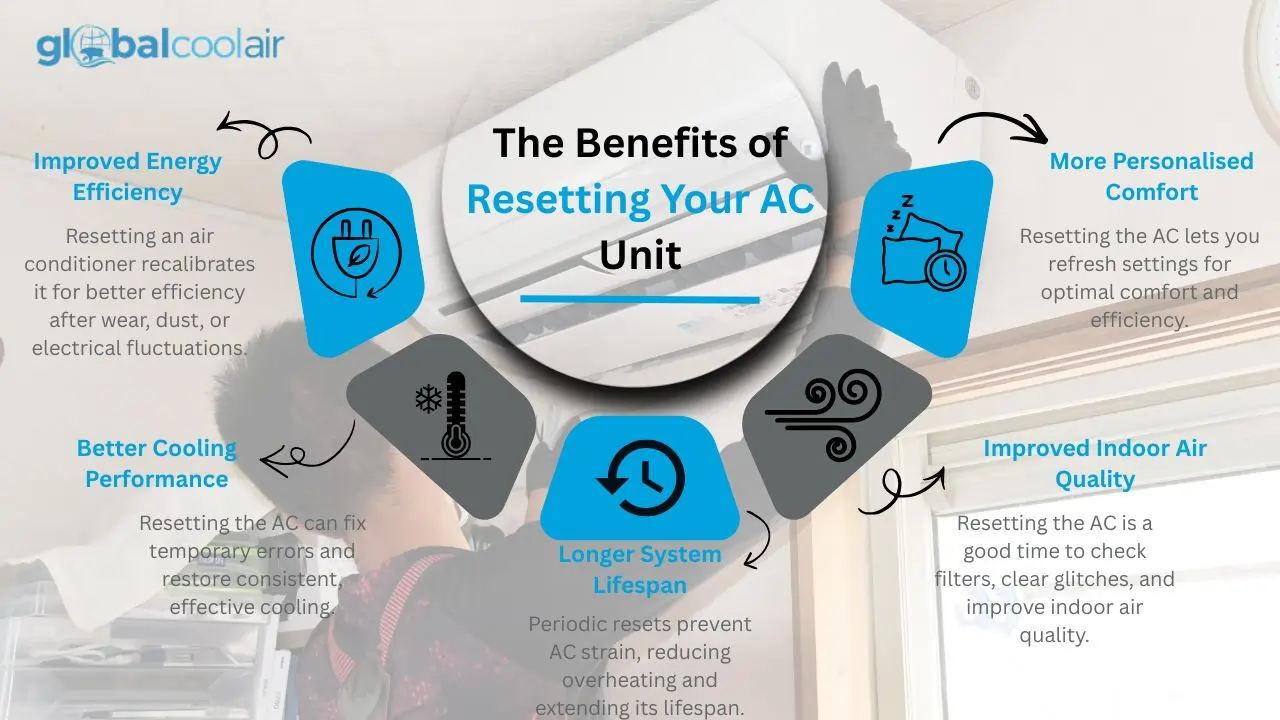
The Benefits of Resetting Your AC Unit
Most people do not consider resetting their air conditioner a regular practice, though it can improve comfort and reduce expenses.
When an air conditioner is not working as expected or its performance is not functioning properly, a simple reset can restore normal operation.
- Improved energy efficiency: Settings and internal controls may become unbalanced over time due to dust accumulation, electrical fluctuations, or daily wear. Performing a reset on an air conditioner can recalibrate the system and help aircon operate more efficiently, potentially reducing energy consumption.
- Better cooling performance: When your system is failing, a reset can remove any temporary software or communication errors. This clean slate helps the unit deliver more consistent, efficient cooling, especially during the summer peak.
- Longer system lifespan: A constantly adjusting air conditioner can work too hard when it encounters mistakes or incorrect settings. Periodic system resets will help avoid unnecessary strain, minimise the risk of overheating, and ultimately increase the unit’s total life.
- Improved indoor air quality: Although an aircon reset does not clean filters, it is a good opportunity to check and refresh them. Healthier indoor air can be promoted by clearing system glitches and cleaning filters.
- More personalised comfort: Resetting your air conditioner lets you start over with your preferred temperature, mode, and fan settings. It enables you to customise the system to your comfort requirements, rather than relying on outdated or ineffective configurations.
Incorporating air conditioner resets into your basic maintenance routine is a simple way to improve performance, save on energy costs, and keep your system delivering reliable cooling in summer and warmth in winter.
Preventative Tips To Avoid The Need For Reset
Although resetting your air conditioner is a quick way to get it working again, manufacturers and air conditioning experts discourage it as a routine measure.
Constant resets can signal hidden problems and may even conceal emergent ones.
Following a few preventive measures can reduce the risk of your air conditioner not working and minimise the need to reset it altogether.
Clean or Replace Filters Regularly
Clogged or dirty filters limit air flow and put unnecessary strain on the system. This additional stress is one of the main causes of an air con not working correctly and may cause error codes that need a reset.
To maintain a smooth-running system, it is important not to keep filters dirty to minimise breakdowns.
Keep Vents and Ducts Clear
Obstructed or blocked vents and ductwork will interfere with air flow and cause pressure imbalances.
When air fails to circulate effectively, the system may not cool properly and emit fault signals, prompting a shutdown and requiring a reset.
Avoiding vent and duct obstructions is another way to maintain consistent performance.
Use a Voltage Stabiliser or Surge Protector
One of the most common causes of system errors and reboots is damage to the control board due to power surges and outages.
A voltage stabiliser or surge protector will protect delicate electronics and reduce the likelihood that the air conditioner will not work after a power issue.
Take a Look at the Thermostat
A faulty thermostat often sends incorrect signals to the system, leading to performance issues or an unintended shutdown.
The thermostat should always be kept clean, batteries should be changed when necessary, and it should be placed in a location that does not receive direct sunlight or extreme heat to prevent unnecessary resets.
Avoid Frequent on–off Cycling
Switching the air conditioner on and off too frequently can confuse the internal controls and may cause the compressor to lock up.
There should be a minimum of 3 to 5 minutes between loops so that the system can stabilise and run properly.
Watch for Early Warning Signs
There are usually signs of failure in air conditioners. Short cycling, inconsistency of temperature, poor airflow, strange sounds, and flashing error codes are warning signs that something is not right.
By solving these problems during the initial stages, one can avoid the air conditioner from stopping and will require fewer manual restarts.
Schedule Regular Professional Maintenance
Regular maintenance checks can help identify minor flaws before they develop into major issues. The majority of specialists suggest that, to maintain your system efficient, reliable, and with a lower risk of restart-required errors, annual maintenance is advised.
Taking a proactive approach to maintenance not only improves performance but also extends the lifespan of your air conditioning system and reduces unnecessary disruptions.

When to Call a Professional Technician
Although resetting your air conditioning system usually solves most minor problems, sometimes professional services are required.
It is always better to know when to stop troubling yourself so that no more damage can be done and your air conditioning system is safe and reliable.
Warning Signs You Shouldn’t Ignore
When your air conditioner is not working even after several attempts at resetting, it is usually because of something more serious.
Persistent issues like the air conditioner refusing to start, failing to work, or shutting down repeatedly are not to be overlooked.
Suspicious sounds, smells, or electrical problems are obvious indications that a certified technician is required.
Safety Risks of Repeated Resets
Repeating a system restart when the air conditioner won’t turn on may pose a safety hazard.
Continuous power cycling can damage delicate electronics or mask major defects, such as wiring or compressor malfunctions.
When your air con is not working after a power outage, and resetting is not successful, it is better to cease and seek professional help.
Cost-Saving Advice Before Repairs
Early specialist assistance can prove to be cost-efficient in the future. When an air conditioner won’t turn on, constant resetting can only aggravate the problem and lead to costly repairs.
Global Cool Air will properly diagnose the issue, explain exactly what you can do, and perform the proper repair the first time.
If you require assistance with any air conditioning matter in Perth, be it repairs, servicing, or problem-solving, Global Cool Air can help.
Our qualified technicians service all major air conditioner brands and systems to keep your home or business comfortable year-round.
Global Cool Air at Your Service
By understanding how to reset an air conditioner, you will save time and frustration, and in most cases, it will start your system without the need for many unwarranted repairs.
If you have gone through the necessary steps to reset an air conditioner and the mechanism still fails to start, it indicates that it needs professional service.
If you require professional assistance in Perth, Global Cool Air is here to help. We are a team specialising in air conditioning diagnosis, safe resetting, and quality repairs and servicing.
Call us or book a service online to have your air conditioner started, running at full capacity and operating reliably, especially when you need it the most.