

Air Conditioning Rebate in Australia: State-by-State Guide to Cooling Support
Summers are difficult, energy costs are a concern, and many old properties in Australia still have inefficient cooling systems that can be too expensive to fix. So, more people are looking for an air conditioning rebate before deciding to install a brand-new system.
An air conditioning rebate is financial assistance that can help offset the cost of purchasing, installing, upgrading, or operating an air conditioner. However, not all aircon rebates are created equal.
Now, the more important question: Are there any government rebates for air conditioners in Australia?
It depends on where you live and what type of support you’re talking about.
Others are upfront discounts. NSW, for instance, provides eligible households with a discount to reduce the cost of installing a new energy-efficient air conditioner or replacing an old air conditioner with a more efficient model.
Some are cashback rebates, meaning you will need to pay up first and then apply for the rebate later. Others are energy bill concessions, which are more of a running cost benefit. In WA, some AC rebates are part of energy concession support, so they’re more of a support for eligible households with cooling costs.
Some locations even offer no-interest or low-interest loans for home energy upgrades and medical cooling concessions for individuals who require greater temperature control at home for medical reasons.
WA’s Thermoregulatory Dysfunction Energy Subsidy is an energy subsidy for eligible individuals to help offset energy costs associated with maintaining a home’s temperature, in accordance with a specialist medical assessment.
There are also government energy-efficiency incentive programs. For instance, Victoria offers discounts on heating and cooling through the Victorian Energy Upgrades scheme, with assistance available to upgrade to an efficient reverse-cycle air conditioner.
This guide explains how air conditioning rebates work in Australia, who can avail themselves of them, what each state offers, and what you must note before hiring professional air conditioning services.
Who Usually Qualifies for an Air Conditioning Rebate in Australia?
Can I actually get an air conditioning rebate? We need to check a few things first.
Always start with the basics:
Your State or Territory
Rebate rules vary from state to state. The NSW air conditioning rebate, the air conditioner rebate in Victoria, or the WA cooling concession can all be different.
For instance, NSW states that the incentive to replace air conditioners may be available to eligible households and small businesses, but only from suppliers that offer it.
Your Household Situation
There are government rebate programs available for many homes. Others are primarily for consumers who have:
- Pensioner Concession Cards
- Health Care Cards
- Commonwealth Seniors Health Cards
- DVA Gold Cards
- Medical cooling needs
- Eligible rental or homeowner status
In WA, the air conditioning rebate may be linked to concession support, which can be based on card type or location.
The System You Already Have
Some air conditioner rebates are not only for installing a brand-new system, but also for replacing an old, less efficient system.
Victoria, for instance, has approved high-efficiency reverse-cycle air conditioners available for heating and cooling discounts. Usually, the system should be at least 2 years old before it is replaced.
The Installer, Product, and Paperwork
This is where people often get caught.
Before booking anything, check:
- Is the installer approved?
- Is the air conditioner model eligible?
- Do you need pre-approval?
- Do you need quotes, invoices, or proof of concession?
- Is the rebate applied before or after payment?
My suggestion is to check the rebate rules before deciding on energy-efficient air conditioners. A government air conditioning rebate may be beneficial, but only if the product, installer, and paperwork all line up.
Air Conditioning Rebate Rules by State and Territory
Avoid taking any kind of air conditioning rebate for granted; look for a general one. The rules in Australia are extremely state-based. The NSW government aircon rebate may be vastly different to the WA aircon rebate or the ACT home energy upgrade scheme.
New South Wales
NSW has one of the clearer options.
The NSW air conditioner upgrade incentive could provide eligible households and small businesses with a discount on getting a new energy-efficient air conditioner or replacing an existing one from an approved supplier.
NSW provides up to $550 for replacing an old air conditioner with a 6kW split system, and up to $560 for installing a new 6kW split system.
Victoria
The main pathway is the Victorian Energy Upgrades program. It provides a discount on heating and cooling services for households that install efficient reverse-cycle air conditioners, with the Victorian government claiming households could save up to $1,610 initially and up to $460 per year on their energy bills when they upgrade their air conditioner to an efficient reverse-cycle model.
But here’s the part people miss:
- The product has to meet VEU requirements.
- The provider needs to be accredited.
- The old system and new system types can affect the discount.
- Retrospective rebates have time limits.
Therefore, when looking for a split system rebate in Victoria, don’t purchase first and ask questions later. Before locking in a reverse-cycle air conditioner, check the rules.
Queensland
In Queensland, things are slightly different. I wouldn’t say to anyone that there’s always a special government rebate for purchasing a new air conditioner, as government schemes in Queensland are subject to change.
What Queensland does have are energy-related supports. The Electricity Rebate ($386.34 per year) may be available to eligible pensioners, veterans and seniors.
Please review the Queensland Government rebate page for the latest rebate program information before purchase. Be sure to look for fresh posts on the government air conditioner rebate.
Western Australia
Because Global Cool Air works in Perth, this is the one I get asked about most.
The WA Air Conditioning Rebate is typically NOT a rebate on the purchase of a new AC unit. It is primarily there to help cover the cost of running an air conditioner for the appropriate household in high-heat discomfort zones.
The amount varies depending on your location, and even permanent residents of caravan parks can apply, the WA Government says.
So if you’re in WA, the big checks are:
- Do you live in an approved high heat discomfort area?
- Do you hold an eligible concession?
- Are you applying through the correct energy provider?
- Is the support for running costs, not installation?
That is why I always remind Perth homeowners not to mistake a WA concession for a government rebate for air conditioning installation.
South Australia
The Retailer Energy Productivity Scheme (REPS) is commonly called REPS in South Australia. This can include efficient heating and cooling procedures, such as installing new, energy-efficient reverse-cycle air conditioners.
The SA Government identifies the following heating and cooling activities: HC2A: Install an Efficient New Reverse Cycle Air Conditioner, Non-Ducted or HC2B: Install an Efficient New Reverse Cycle Air Conditioner, Ducted or Multi-Split.
For SA, the details can depend on:
- The activity being claimed
- Whether the system is ducted, non-ducted, or multi-split
- The installer or provider
- Product requirements
- Whether the home qualifies
If someone is looking for government air conditioning rebates in South Australia, I would say: look at REPS first; check with the air conditioning provider to ensure it is a real rebate; and then consider a multi-split system as the next option.
Tasmania
In Tasmania, while there may be energy support, medical cooling and heating concessions, and financing-style assistance, it’s important to note that homeowners should not assume there is always a dedicated air conditioner rebate for installation.
Tasmania’s electricity concession is a day-to-day discount that is detailed on the national energy.gov.au rebates page. It also includes a medical cooling or heating concession for eligible Tasmanian customers who require a cooling or heating service to their primary home to manage a medical condition.
Energy efficiency support has also been provided in Tasmania, including interest-free loans for products such as reverse-cycle air conditioners and heat pumps.
Australian Capital Territory
The ACT has some of the strongest home energy support options.
The Home Energy Support Program offers rebates of up to $5,000 for reverse-cycle heating and cooling, with one rebate in the form of 50% of the supply and installation cost, up to $2,500. The Sustainable Household Scheme offers eligible homeowners a zero-interest loan of up to $10,000.
For ACT households, I’d check:
- Do you own the home?
- Do you hold an eligible concession card?
- Is the upgrade an approved energy-efficient product?
- Can the rebate and loan work together?
If you’re looking at different aircon systems, this is a good illustration of a home heating and cooling rebate that might cover initial upgrade costs.
Northern Territory
I’d seek concessions and bill relief first, rather than a dedicated air conditioning rebate for a new unit, for the NT.
The NT Government says eligible households can get energy bill relief of up to $150, and notes this is different from the electricity concession under the NT Concession Scheme. The national energy.gov.au rebates page also lists the NT Concession Scheme, which offers discounts on electricity bills.
So for NT households, I’d check:
- NT Concession Scheme eligibility
- Energy bill relief
- Medical or household support programs
- Current NT savings finder listings
My tip: If you’re considering purchasing air conditioning in the Northern Territory and wondering about a government subsidy, please double-check the current Northern Territory pages before your purchase.
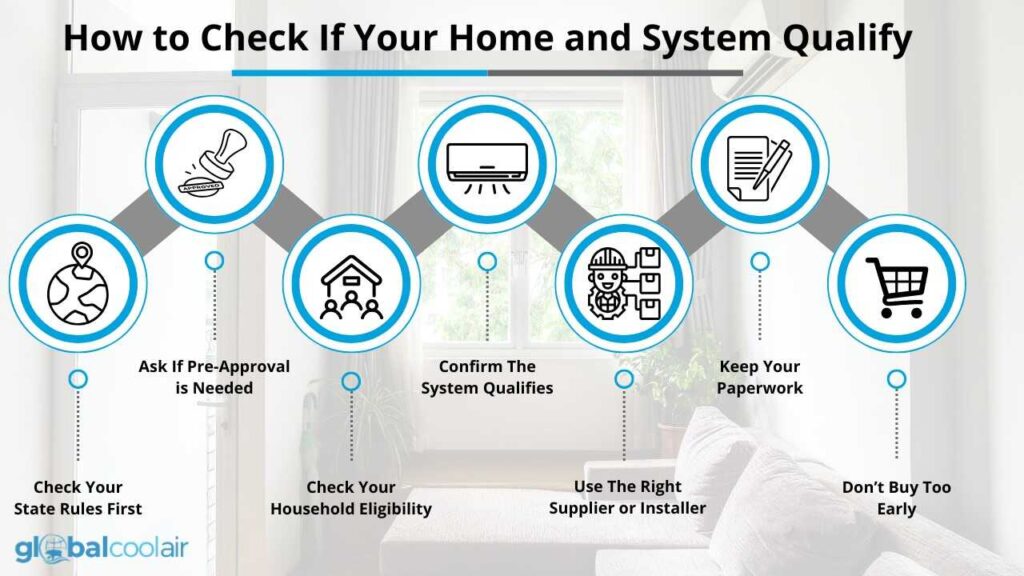
How to Check If Your Home and System Qualify
Here is the checklist that I would use onsite before people start getting excited about an air conditioning rebate.
Step 1: Check Your State Rules First
Begin on a government page in your state or territory and not on a random rebate post. NSW, for instance, claims that its air conditioner incentive is included in the quote up front, and it may also depend on the installer servicing your area.
Step 2: Ask If Pre-Approval is Needed
This one matters. Some programs require approval before work begins. The ACT Home Energy Support Program recommends that applicants not accept a quote until they have received approval.
Step 3: Check Your Household Eligibility
Your household environment may impact the outcome. It may be necessary to verify whether you are a homeowner, renter, concession card holder, small business, or seeking medical cooling assistance.
Step 4: Confirm the System Qualifies
Not all air conditioner rebates necessarily cover all air conditioners. Victoria needs a high-efficiency reverse-cycle air conditioner that is approved, and the provider has to ensure which models are approved.
Step 5: Use the Right Supplier or Installer
Aircon rebates programs are only available via approved or accredited providers. An accredited provider can add it to the quote, install and process paperwork, says Victoria.
Step 6: Keep Your Paperwork
Keep:
- Quotes
- Invoices
- Proof of eligibility
- Product details
- Any approval emails
- Installer certificates
Step 7: Don’t Buy Too Early
This is the major error. The government air conditioning rebate may require prior approval, and if so, purchasing early may mean missing out on it.
In addition, determine the required size of the air conditioner before applying. The size of a split system AC may affect comfort levels, efficiency, and whether it qualifies for the rebate.
Can You Use a Rebate to Replace an Old System?
Yes — in many cases, the air conditioning rebate is designed to incentivise homeowners to replace older, power-consuming systems.
This is typically the goal: to reduce energy loss, save on running expenses and achieve a more efficient house.
What Systems are Often Being Replaced?
Pay attention to systems like:
- Old electric heating or cooling units
- Outdated air conditioners that struggle in summer
- Inefficient heating and cooling setups
- Units that cost too much to run
- Systems that keep needing callouts and patch-up work
Repair or Replace?
Here’s my honest technician view: not every old unit needs replacing straight away.
However, if the problem is relatively small and the cooling system is still operating efficiently, it may be better to opt for air conditioner repair services. However, if the unit is outdated, costly to operate, or struggles to cool effectively, it might be better to replace the AC unit.
Don’t Forget the Old Unit
Removal, decommissioning or proper documentation of the old system may be required in some rebate programs. Before work begins, there are some activity rules in South Australia for REPS to consider when installing efficient reverse-cycle air conditioners.
So before banking on a government air conditioning rebate, check what happens to the old unit first.

Common Mistakes That Can Cost You the Rebate
Don’t miss out on an air conditioning rebate for simple reasons — not because you chose a bad system, but because they skipped one small step.
Mistake 1: Buying Before Checking the Rules
This is the big one. Some programs require the discount to be applied before work begins. NSW claims that household energy-saving incentives are up-front discounts included in the estimate and can only be offered by installers who have joined an Accredited Certificate Provider.
Mistake 2: Using the Wrong Installer
A government air conditioning rebate may only apply to an approved or accredited provider. In Victoria, the Accredited Provider confirms eligible models, quotes with the discount, installs the system and completes paperwork.
Mistake 3: Choosing the Wrong Product
Some units are not eligible for an air conditioner rebate. An approved high-efficiency reverse-cycle air conditioner will be required in Victoria, and eligible systems must meet the scheme’s product requirements.
Mistake 4: Missing Pre-Approval
Some rebates are hard to come by. The ACT instructs applicants to hold for approval and not take a quote until the application is approved.
Mistake 5: Forgetting Paperwork
Always keep:
- Quotes
- Invoices
- Proof of concession
- Product details
- Approval emails
- Installer certificates
Mistake 6: Waiting Too Long
Programs may be modified and discontinued. NSW’s cheaper, energy-efficient air conditioner offer will end in June 2027 – or sooner if the funding runs out.
My Final Tip
Please ensure you review the rules before counting on an aircon rebate. Missed timing, wrong product, installer, or missing documentation can result in lost support you may have qualified for.
Conclusion: Check Your State Rules Before You Buy
From what I see as an air conditioning technician in Perth, the biggest thing to remember is this: air conditioning rebates vary across Australia.
A NSW aircon rebate, an air conditioner rebate in Victoria, or a WA cooling concession can have different rules. Some support installation, some help with replacement, some reduce energy bills, and others are for medical cooling needs. That’s why it’s important not to assume every air conditioner government rebate applies to your home.
At Global Cool Air, we can help with anything air conditioner-related, from choosing the right system to installation, replacement, servicing, and repairs. We’ll help you understand what suits your home, your budget, and your cooling needs.
Need help choosing the right air conditioner? Contact us today, and let’s find the best option for your home before you commit to a system.


Get Your Aircon Quote Today
Request a free air conditioning quote and let our Perth team guide you.