Regardless of how hot it is inside the house, an air conditioner is not something one should purchase on a whim. It is a significant investment that not only makes you more comfortable but also affects your electricity bills. Hence, it is well worth your time to conduct thorough research before making an investment.
Getting the appropriate air conditioner size is even more critical if you intend to operate it all year round, both during the summer and the colder months. There is a risk of poor temperature control and higher operating costs when the wrong unit is used.
Hot climates, such as those in Australia, can give the impression that bigger is better, but in the case of aircon sizes, this is not always suitable. The key is to match the air conditioner size to your room’s layout, insulation, and local climate.
So, what size air conditioner do you need? Or, more specifically, what size air conditioner do you need for your room?
We will take you through all you need to know. This guide will help you make an informed decision on the ideal AC size for your home.
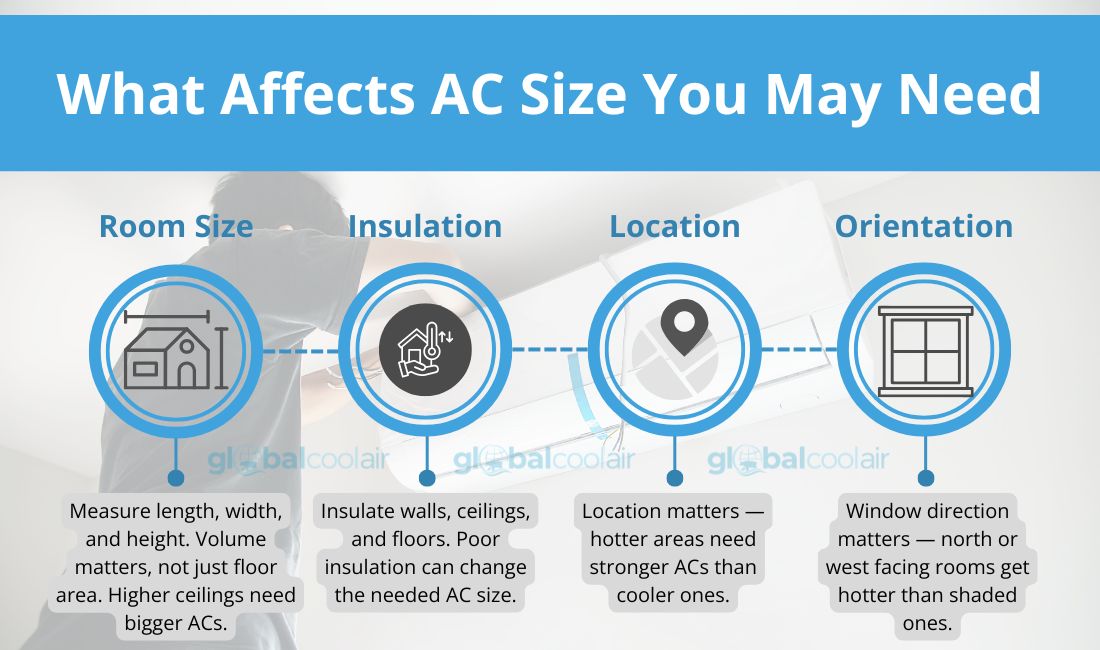
What Affects the Size of the Air Conditioner You Need?
It is so tempting to think that the size of your room is the sole determinant of the air conditioner size you require. While the room size of an air conditioner is certainly an important factor, every home is unique, and several other elements influence what air conditioner size or capacity will work best.
You should get a closer look at the room and the environment of your house before making the final decision on what air conditioner you need. Personally, I was able to save hundreds on my latest purchase because I chose a smaller model with the perfect air conditioning sizing that fits my space.
When calculating the size of air conditioning you need for your room, four important considerations are involved.
- Room size: Measure the length, width, and ceiling height. Total room volume matters — not just floor area. A room with higher ceilings may require a larger air conditioner size.
- Insulation: Ensure that your walls, ceilings, flooring, and any other exposed surfaces are properly insulated. Poor insulation may alter the intended size of the aircon for the room.
- Location: Where you live plays a big role. For example, a home in Darwin will need a more powerful unit than the same room size air conditioner setup in Hobart.
- Orientation: The direction of your windows makes a difference in terms of heat. A north- or west-facing room will become significantly hotter than one that is shaded.
Calculating What Size Air Conditioner You Need
There are air conditioning size calculators and installers that use a simple analysis. Still, their advice is likely to result in you using a unit that is bigger than you actually require.
The heat load calculators created by the Australian Institute of Refrigeration, Air Conditioning and Heating (AIRAH) are a great resource.
This tool can help you evaluate the position of the window and insulation, providing a true picture of the correct air conditioner size for your room.
Calculators can also be found on the websites of manufacturers or installers, but keep in mind that they tend to overestimate capacity, and therefore will recommend a larger AC size or air conditioning unit than you actually need.
Air Conditioner Room Size Chart
Although it is advisable to calculate the size of an air conditioning system that takes into account insulation, window orientation, and climate, it is helpful to start with an approximate value.
To give you a general idea of what size air conditioner or what size aircon might suit your space, here’s a simple aircon size guide showing the approximate air conditioner capacity needed for different room sizes — from a compact bedroom to a spacious lounge.
This aircon size guide will provide a rough estimate of the size of air conditioner that may be suitable for your room size.
This can serve as a guide for determining the appropriate air conditioner size for your room.
| Room Size | Approx. capacity | Price |
| Small (up to 20m2) | 2 – 2.5kW | $600 – $3300 |
| Medium (20–40m2) | 2.5 – 5kW | $600 – $4700 |
| Large (40–60m2) | 4 – 6kW | $800 – $4700 |
| Extra large (60+m2) | 5 – 9kW | $1200 – $4700+ |
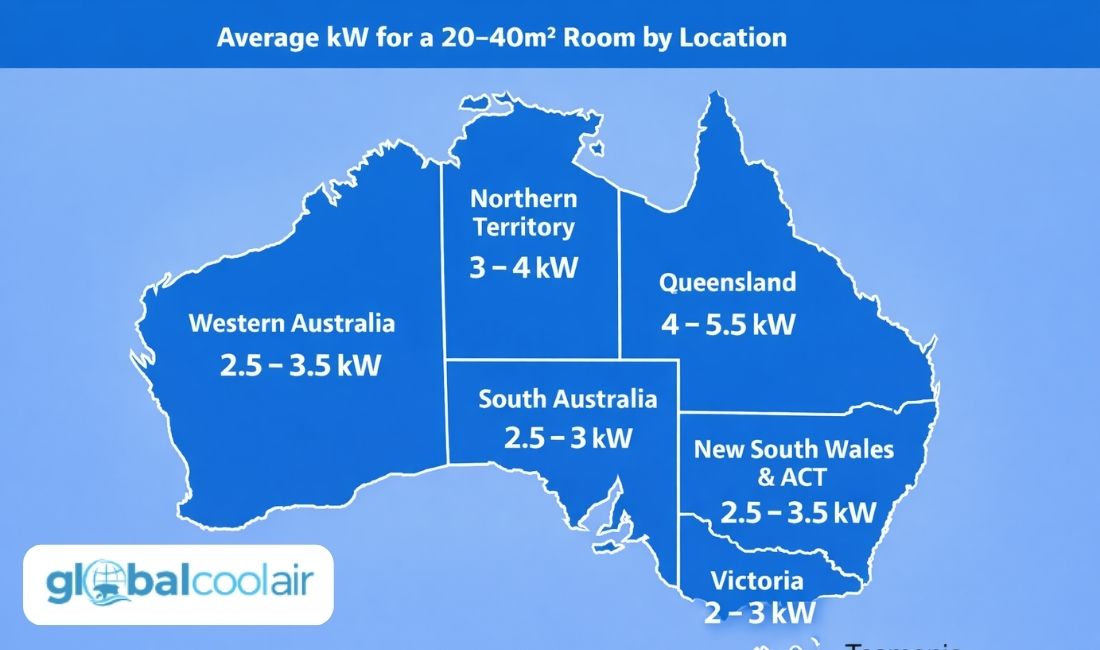
How Where You Live Makes a Difference
As discussed, the size of the air conditioner you will need will be highly dependent on your local climate. The warmer and more humid your area, the higher the cooling capacity you need to make your home comfortable.
For instance, in Darwin, you would likely require a larger air conditioner than in Brisbane due to the increased heat and humidity.
Likewise, in sunny Perth, the air conditioner size for the room will need to be larger than in the cooler climate of Tasmania.
Why the Right Size Matters
Making the wrong capacity selection will result in a system that is either overstretched or wastes energy unnecessarily.
Do not be tempted to shrink your home to a smaller size to save money, or to expand it to a larger size, hoping to stay cool in your home. To achieve optimal outcomes, a combination of air conditioners of different sizes can be used in your home. For example, a larger air conditioner in the living room and a smaller one in a bedroom or study can provide comfort and efficiency.
Remember, the size of the air conditioner is also a factor in the cost of installation and replacement, so striking the correct balance is important.
Big may not necessarily be better, and small may not necessarily be more cost-effective. Aim for the sweet spot.
This is what may occur when you over-size or under-size your air conditioning system, and why appropriate air con sizing is important.
Too Big
When you have an air conditioner that is oversized, the machine will power up in short, frequent bursts to reach the desired temperature. This kind of air con sizing issue can result in the following issues:
- The room becoming too hot or too cold as the system cycles on and off too quickly.
- Poor dehumidification, leaving the air feeling sticky or uncomfortable.
- Increased power consumption and higher running costs
- Greater wear and tear on the unit, shortening its lifespan
Too Small
When your air conditioner is too small, it may be necessary to turn it to maximum output too frequently just to keep the temperature comfortable. The possible problems that this type of air conditioning problem can cause include:
- The air becoming overly dry and uncomfortable.
- Increased wear and tear on the system due to constant strain
- Higher power consumption and energy bills
Air Conditioning Size Formula
To determine the most suitable air conditioner size for your main living areas, start by calculating the total area of these areas.
Measure the length and width of each room, and multiply them together to determine the area. Add the areas of each space that are linked together to obtain the overall square metres.
This formula can be taken as a general guide: Room Size (m²) × 150 watts = AC Size.
This will give you an approximation of the size air conditioner you need, which may be suitable for your space. However, bear in mind that this is just an approximation; other elements, such as insulation, window position, and ceiling height, may also influence the necessary capacity.
If you’re unsure about the size of air conditioner needed for a bedroom, living room, or any other room, consult an air conditioning size chart to determine the ideal size for a room.
What Are the Factors Affecting Air Conditioner Efficiency?
When cooling your home, it’s essential to select the right-sized air conditioner. Although the size of your air conditioner is a significant factor, it is not the only one to consider when determining the best air conditioner size for your home.
For example, although your neighbour or friend has a home of the same size as you, your ideal AC size might be different depending on various factors, such as the degree of tree shade or the number of windows facing the afternoon sun.
These factors may affect the cooling performance of your air conditioner and thus affect what size air conditioner you need, including:
- The thickness of plasterboard and the level of insulation in your home
- How hot and humid do your summers get
- The amount of sun exposure or shade your home receives daily.
- The number, design, and insulation quality of your windows
- Ceiling height, since greater air volume impacts efficiency
- The condition of existing ductwork in your home
- The number of occupants in a room at any given time
- Whether duct cleaning has been maintained
- Your roof material (tiles vs tin)
All these can have a great impact on the performance and energy consumption of your system.
That is why they should be considered before you finalise air conditioner sizing. If you’re unsure, consult an HVAC specialist who will inspect your home and help you choose the correct size air conditioner for the room to achieve optimal comfort and efficiency.
AC Size Isn’t Everything
AC size is significant, but it is not the only parameter that defines comfort or efficiency. Most individuals consider the size of the air conditioner or the power in kilowatts; however, there is more to selecting the appropriate cooling solution for your home or business than just numbers. In fact, several other factors may affect performance, which proves that aircon size is not the only factor.
It is important to consider these before deciding on what size air conditioner you need to ensure that you have the most effective and efficient air conditioning set up to suit your space:
Types of Systems
There are various air conditioning systems available, depending on your specific cooling requirements and the room size. Both options suit various spaces and air conditioner sizes; therefore, it is worth knowing which one best suits your home or business.
Common types include:
- Split System Air Conditioners
- Multi-Head Split System Air Conditioners
- Ducted Air Conditioning
- Portable Air Conditioners
- Evaporative Air Conditioners
Air Conditioner Brands
Australia has numerous acceptable air conditioning brands. Others are recognised to have a great energy star rating, and some are concerned with high-level features that add comfort and convenience.
Mitsubishi Electric and Daikin are excellent choices if you require quiet performance and high efficiency. The Daikin and Fujitsu brands are also renowned for their reliability, featuring high-quality systems that are highly energy-efficient.
Energy Efficiency
Energy efficiency rating is also a key element to consider when selecting an air conditioner. Air conditioners in Australia have an energy consumption rating on a 10-star scale – the higher the number of stars, the more efficient the unit.
Inverter air conditioners are a great option if you value both energy savings and optimal performance. These systems can regulate their output to ensure they operate at a constant temperature, rather than switching on and off frequently. They are more efficient and cost less to operate.
Extra Features
ACs with more functionalities tend to be more expensive; however, they are also much more comfortable, convenient, and healthier. When deciding on a new unit, examine the features that are the most important to you and your home.
A dehumidifier, reverse-cycle heating and cooling, smart connectivity, air filters to eliminate odours, anti-fungal protection, turbo cooling, rustproof base pans, remote control, and timer are some of the key options to consider.
These extras may increase the cost, but they can help improve performance and make your air conditioner more efficient, meeting your unique requirements.
Look for a Professional AC Installer!
You may need advice on determining the correct size of an air conditioner or guidance on its installation. In any case, hiring a professional air conditioner installer is essential to ensure you have an efficient air conditioner that will last for a long time.
In Australia, an air conditioning professional is required to perform the AC installation. They are not only able to assist in determining the right size of the air conditioner but also ensure that the system is installed safely and efficiently.
The licensed installers at Global Cool Air are well-trained and certified to handle refrigerants safely, minimising the risks of flammability, toxicity, and other forms of bodily harm.
Using the services of an expert will provide you with the peace of mind that your air conditioning system will be installed correctly, safely, and in accordance with Australian standards, ensuring your chosen air conditioner size provides maximum comfort and efficiency.
Call us and get why people ask for us.