

Types of Air Filters for HVAC
When I check an air conditioner, the filter tells me plenty about how the system has been maintained. Good HVAC system filters help maintain cleaner airflow while protecting internal parts from dust and debris.
Australian homes may contend with household dust and pollen, pet hair and dander, bushfire smoke, and other airborne particles.
At Global Cool Air, we remind customers that no filter removes every gas, virus or allergen. Filtration works best alongside ventilation, cleaning and moisture control to improve air quality. The Australian Department of Health also recommends appropriate filtration during periods of outdoor air pollution.
This guide compares the main types of air filters to help you find a practical option for your system.
What Does an HVAC Air Filter Do?
One of the first things I check when I look at an air conditioner is the filter. The air is drawn through the air conditioner filter material before it enters the HVAC system. The filter captures dust, pollen, pet dander and other debris that the air may carry.
Its two main jobs are to:
- Protect coils, fans and other internal parts from dust and debris
- Reduce the amount of certain airborne contaminants recirculating indoors
These factors, including the type of air-conditioning filter material, particle size, airflow, and how tightly the filter fits, affect the performance of the types of HVAC filters. Air may leak in between the edges if there are gaps.
When researching types of air filters for HVAC, keep in mind that an HVAC filter is not the same as a portable air purifier. A purifier typically purifies a single room, while an HVAC filter purifies the system. Some models have an air conditioner with air purification options.
As we say at Global Cool Air, ventilation, moisture control, and regular cleaning can’t be replaced by more sophisticated types of air filters. This is in line with Australian Department of Health and US EPA guidance.
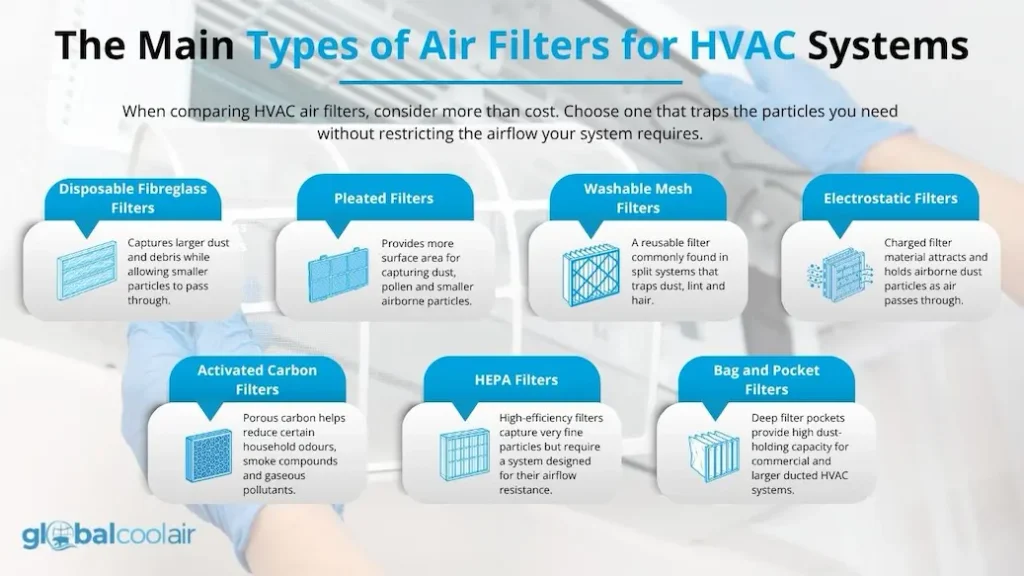
The Main Types of Air Filters for HVAC Systems
If you’re comparing different types of HVAC air filters, look beyond the cost of a filter. The correct choice should adequately trap the particles you’re concerned about without impeding the airflow your system requires.
Disposable Fibreglass Filters
Disposable fibreglass filters have a simple flat-panel design. The barrier is a lightweight material made of layers of spun fibreglass suspended inside a cardboard or metal frame and is designed to trap larger particles.
Easy to install for some ducted heating and cooling systems. They’re also low-priced and have relatively low airflow resistance. They typically let smaller particles, such as smoke and other allergens, pass through.
Pleated Filters
Pleated filters are made by creating a series of folds in polyester, cotton or other synthetic material. This allows the filter to capture more dust without requiring a much larger frame, thanks to the increased surface area created by these folds.
Pleated filters typically have greater efficiency at trapping particles than flat filters at capturing particles people can inhale, according to the US Environmental Protection Agency.
But a larger filtration rating doesn’t necessarily mean it is better for your unit. If the fan is not designed to accommodate dense HVAC system filters, these filters can cause resistance and restrict airflow. Even energy-efficient air conditioners can perform poorly if the filter is not installed correctly or is too dirty or clogged.
At Global Cool Air, we always evaluate system requirements before making any upgrade recommendation.
Washable Mesh Filters
Washable mesh filters are the type I most often come across in residential wall-mounted split systems. These are typically made from a light frame with a fine plastic mesh between them.
Their biggest advantage is reusability. Basic maintenance normally involves:
- Switching off the air conditioner
- Carefully removing the filters
- Vacuuming or rinsing away loose dust
- Washing them as directed by the manufacturer
- Allowing them to dry completely
- Reinstalling them securely
Do not put a wet filter back in the filter unit. Water that’s trapped can lead to foul odours or mould.
These filters are great for removing dust, lint and hair, but most basic mesh filters are not configured to trap very fine particles. Check out our full guide on how to clean a split system AC, and how often to clean an aircon filter.
Electrostatic Filters
Electrostatic filters use an electrically charged fibre or material to attract airborne particles. It is somewhat like a light static action that helps the dust stay on the filter rather than getting blown back.
You will generally find two options:
- Disposable electrostatic filters that are replaced when dirty
- Permanent electrostatic filters that can be washed and reused
They can help in homes where dust is a chronic problem. But there are differences among products in filtration efficiency. Some washable options also become ineffective if not cleaned properly or reinstalled while wet. Before switching to a different type of filter, I recommend consulting the air conditioner manual.
Activated Carbon Filters
Unlike normal dust, activated carbon filters are used to remove odours and some gaseous pollutants. Because of its porous nature, the carbon can attract certain compounds, leaving them on its surface.
These filters may help reduce odours associated with:
- Cooking
- Pets
- Tobacco smoke
- Some household chemicals
Carbon filters are often combined with particle filters because the two serve different purposes. The carbon layer reacts with certain odours or gases, and the particle layer traps dust.
The performance is affected by the amount of carbon in the filter and the time that the air is in contact with the filter. The capacity may be limited in a thin carbon sheet, so product claims should be carefully evaluated.
HEPA Filters
A HEPA filter, or true HEPA filter, is a high-efficiency particulate air filter that can remove at least 99.97% of particles that are 0.3 microns in size (under test conditions). Very fine dust, pollen, mould spores and other small particles can be caught by HEPA filtration.
HEPA filters are commonly used in:
- Portable air purifiers
- Medical and laboratory settings
- Specially designed ventilation systems
- Compatible whole-building filtration systems
The Australian Department of Health recommends appropriately sized HEPA filtration as one measure to reduce certain indoor air pollutants.
But I would not ever put a true HEPA filter in a normal house air conditioner without checking. It is very resistant, which can prevent air circulation and, consequently, increase the load on the fan. The best thing to do before upgrading this kind of filter is to have a professional evaluation.
Bag and Pocket Filters
Bag and pocket filters contain deep sections of filter media that extend behind the frame. This gives them a large surface area and greater capacity to hold dust.
These are more likely to be found in commercial HVAC systems and larger ducted systems than in residential split systems. Correct dimensions, filter housing, and available airflow are critical. If the filter is not tight or creates excessive resistance, it will not achieve the desired effect.
Across all these types of air filters, the best choice is the one that fits your system and the particles you’re looking to manage. Global Cool Air can exceed the manufacturer’s specifications, and you won’t be shooting yourself in the foot by picking a filter that dazzles the eye but fails to function in real-world use.
HVAC Air Filter Comparison Table
If you are comparing different types of HVAC air filters, you have to look at what each filter removes, where they are typically installed, and whether the system will allow proper airflow.
| Filter Type | Captures | Reusable | Typical Application | Main Limitation |
|---|---|---|---|---|
| Fibreglass | Large dust and debris | No | Basic HVAC systems | Limited fine-particle filtration |
| Pleated | Dust, pollen and smaller particles | Usually no | Residential and commercial HVAC | Dense media may restrict airflow |
| Washable Mesh | Dust, lint and hair | Yes | Split systems | Limited fine-particle capture |
| Electrostatic | Dust and airborne particles | Sometimes | Selected residential systems | Performance varies |
| Activated Carbon | Odours and certain gases | Usually no | Combined filtration systems | Does not replace particle filtration |
| HEPA | Very fine particles | Usually no | Air purifiers and compatible HVAC | High airflow resistance |
| Bag or Pocket | Moderate and fine particles | Usually no | Commercial or large ducted HVAC | Requires suitable filter housing |
Filter availability, dimensions and compatibility also vary between models and AC brands. At Global Cool Air, we check the manufacturer’s specifications before changing filter types.
Which Filters Are Used in Different Air Conditioning Systems?
There are different types of air filters for HVAC systems, depending on the system type.
Split Systems
The mesh filters for wall-mounted split-system air conditioners are usually removable and washable. This aircon filter material prevents dust, lint and hair from entering the indoor coil.
Some models also include:
- Deodorising filters
- Allergen filters
- Fine-particle filters
The main mesh filter may be washable, but additional filters should be replaced. Always read the manufacturer’s instructions – schedules vary by model.
Multi-Split Systems
In a multi-split air conditioning system, the filter is typically installed in each indoor unit. A unit in a living room used daily can accumulate dust more quickly than a unit in a spare room.
We advise you to test each unit individually at Global Cool Air. Never assume that all HVAC system filters need to be cleaned at once.
Ducted Systems
The filter is larger in ducted air conditioners. Its air-conditioning filter material can be washable, disposable, or a professionally fitted, higher-efficiency product.
Correct dimensions matter. Gaps can cause air to bypass the filter, while air conditioner filter material that is too thick can reduce airflow when not used in a system designed to accommodate it.
Reverse-Cycle Systems
Reverse-cycle air conditioners have filters that operate in both heating and cooling modes. These systems might be operating year-round, so it is recommended to check the air-con filter material regularly.
The Australian Government’s energy guidelines state that efficient operation is achieved by cleaning intake filters. Daikin Australia also recommends following the unit manual for washable types of air filters and drying them before refitting.
How to Choose the Right HVAC Filter
The first step in selecting air filter types for HVAC is to follow the manufacturer’s advice. A filter can claim to capture particles very efficiently, but it must also match the AC.
Before choosing HVAC system filters, check:
- Exact filter dimensions and how securely the filter fits
- The airflow capacity of the system
- The particles the household wants to reduce
- Allergies or respiratory sensitivities
- Pets, bushfire smoke and renovation dust
- Whether the filter is washable or disposable
- Purchase price and replacement frequency
- How easily it can be accessed for maintenance
Washable mesh may be used regularly for dust control, while pleated media may be used in compatible systems to capture finer particles. Carbon filters might work for some odours, while specialist air purifiers might be more appropriate for homes that require more extensive filtration.
Cleaning and Replacing HVAC Filters
The appropriate maintenance procedure depends on the types of air filters in your HVAC system. Reusable filters can almost always be cleaned; disposable HVAC system filters need replacing. A disposable filter should never be washed, as it may damage the filter media and decrease the filter’s efficiency.
A Simple Filter-Care Routine
Here is the process I recommend:
- Turn off the air conditioner.
- Remove the filter following the unit manual.
- Check for dust, damage, mould or deterioration.
- Clean a reusable filter or replace a disposable one.
- Let washable filters dry completely in the shade.
- Refit the filter securely and in the correct direction.
Follow all manufacturer’s instructions. Filters made from different materials, air conditioner designs and operating conditions will have different maintenance intervals. Frequent checks may be required for homes with pets, lots of dust, a frequently used aircon, or nearby construction work.
Regularly cleaning the filter is helpful but not a substitute for a complete system cleaning. Global Cool Air’s informative guide will outline the frequency of AC servicing. For ducted filters, I suggest seeking professional help if they are hard to access or if mould or dirt is visible inside them.
Signs Your HVAC Filter Needs Attention
No matter what types of air filters for HVAC are installed, a dirty filter will show a few warning signs before airflow becomes significantly inhibited.
Check your filter if you notice:
- Visible dust, discolouration or deterioration
- Weak airflow from the vents
- Longer heating or cooling cycles
- Rising electricity use
- Dust returning soon after cleaning
- Unusual smells when the system starts
- Dust collecting around the return-air grille
- More noticeable allergy symptoms indoors
- Ice, water leaks or declining performance
If the AC is still not working well after checking the filter, then you should consider booking an air conditioner repair. Global Cool Air can determine the actual cause of the issue rather than assuming that one type of air filter is to blame.
Final Thoughts: Find the Right Type of Filter for Your HVAC System
No single filter suits every home or air conditioner. Among the types of air filters for HVAC, washable mesh filters catch larger debris, pleated media capture finer particles, electrostatic filters attract dust, carbon filters target certain odours, and HEPA filters handle very fine particles.
But it must suit the unit. Always balance particle capture with airflow, compatibility and realistic maintenance.
Unsure which type of air filter you need? Global Cool Air can inspect your HVAC system filters, recommend a suitable arrangement and provide ongoing air conditioning services across Perth.
Contact us to arrange an inspection or request practical advice.


Get Your Aircon Quote Today
Request a free air conditioning quote and let our Perth team guide you.